
Interview: Mims Sully

Mims Sully is a prize-winning poet from Sussex, England, who writes for both adults and children. Her poetry for children has been published in Tyger Tyger, The Dirigible Balloon, The Changeling, The Toy and Little Thoughts Press. When not writing, she enjoys baking, swimming, playing board games and exploring the countryside.
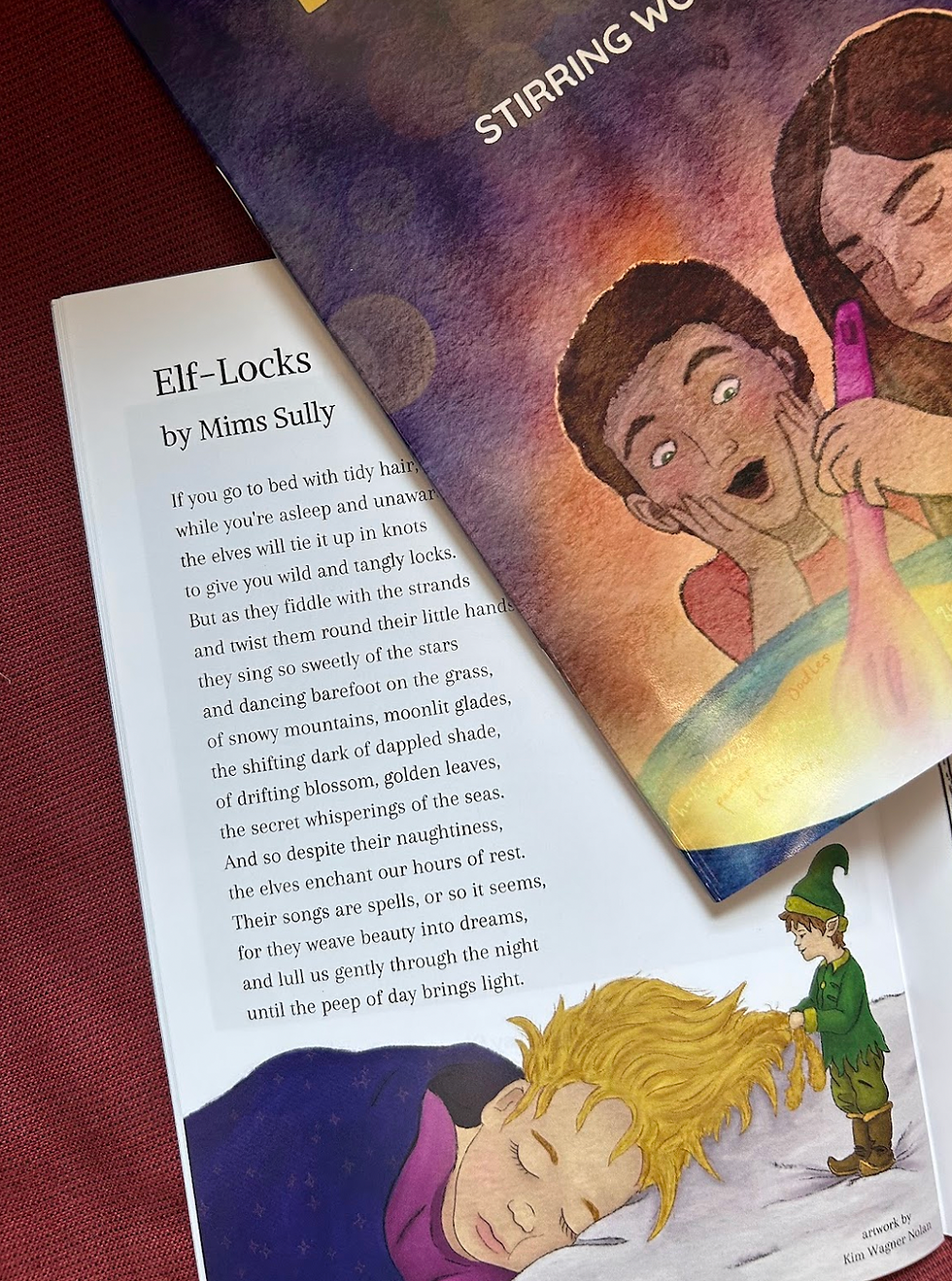
Little Thoughts Press: "Elf-Locks" starts out sounding as if it’s going to be a light-hearted, slightly silly poem about hair tied up in knots by mischievous elves, but at line 7 it takes an unexpectedly lyrical turn, transporting the reader into a world of moonlit glades and drifting blossom. Did you plan this turn, or did the poem take on a life of its own as you were writing it?
Mims Sully: I think most poems take on a life of their own as you write them. What starts off with the spark of an idea often develops in surprising directions as your imagination takes flight. The opening of "Elf-Locks" came easily as I simply described the meaning/origin of the word in folklore. I love the idea of elves as mischief-makers tangling up children's hair as they sleep giving them elf-locks in the morning. But then I found myself wondering is there more to this than naughtiness? And why don't their antics wake the children in the night? Pondering these questions inspired the 'lyrical turn' and the rest of the poem as I imagined the elves singing songs that act like lullabies, or magic spells, keeping the children undisturbed in dreamland.
Little Thoughts Press: What advice do you have for young writers who would like to use a folktale as the basis for a poem or story?
Mims Sully: Because fairytales traditionally use stock characters, or rather stereotypes, such as the evil stepmother, the beautiful princess etc, my advice is to put yourself in a character's shoes and imagine how you would feel, think and act in their place. This will make the characters seem more human and give your writing emotional depth. Exploring the fairytale in this way will also help you to develop your own authentic voice and give a unique slant to your writing.
Little Thoughts Press: Our Stirring Words issue is all about odd, interesting, or inspiring words and phrases. What is your favorite word right now? Why do you love it?
Mims Sully: My dad used to say that elbow was the most beautiful-sounding word in the English language and I have inherited his love for it. I like how soft and poetic it sounds, yet it literally means 'arm-bend' in Old English. I've always liked the word chinwag because it amusingly describes the movement of people's chins as they talk. However, my favourite word right now came out of a typo in a text to my partner. I meant to write darling but instead I wrote farling—a portmanteau, or made-up word fusing together far and darling, which I think is a lovely way to describe a loved one when you're apart.
Little Thoughts Press: Why did you choose the word(s) you chose to feature in your Stirring Words piece?
Mims Sully: I enjoyed reading through the Stirring Words list, kindly provided by guest editor Jennifer Thomas, to help inspire new writing. When I came across the word Elf-Locks, I was intrigued as I love anything to do with folklore. When I found out what it meant, I knew I had to write a poem about it as I wake up every morning with bed head and now I know why! I also sneaked in another word from the list: day-peep (but it appears as the phrase 'the peep of day' in my poem). It is an archaic term meaning 'dawn', or 'the break of day'. I love how lyrical it sounds and how it evokes the image of the sun glancing furtively over the horizon as it rises.
Little Thoughts Press: How did you get started writing kid-lit and what do you find most challenging and rewarding about writing for kids?
Mims Sully: I responded to a call-out for a children's magazine with a couple of poems that fit the theme but that hadn't been written specifically for children. When one got accepted for publication, it encouraged me to think that writing for children might be something I could pursue. A little while later, my then three-year-old niece told me a story about giving a funeral for a bee she had rescued too late from a spider's web. I was so touched by her tale that I wrote her a poem about it—my first ever children's poem. From then on, I was hooked.
One of the most challenging aspects of writing for children is finding words that both rhyme and express your desired meaning (children's poetry doesn't have to rhyme but sometimes I feel a poem requires it). That said, it is so satisfying when you do stumble upon those words and your poem finally comes together, a bit like a jigsaw puzzle.
Little Thoughts Press: Which kid-lit authors and books were your favorites growing up?
Mims Sully: I grew up on such classics as the fairytales of Hans Christian Andersen and the brothers Grimm, Aesop's Fables, the Just So Stories by Rudyard Kipling, and Atticus the Storyteller's 100 Greek Myths. I was and still am a massive fan of Roald Dahl's books, especially The Giraffe and the Pelly and Me, The Magic Finger, The BFG, and his poetry collections: Revolting Rhymes and Dirty Beasts. I loved Burgler Bill and Funny Bones by Janet and Allan Ahlberg. Babette Cole's Princess Smartypants and Frank Muir's What-a-Mess books were also firm favourites. I was obsessed with the Goosebumps series by R.L. Stine. And I devoured all the Usborne Puzzle Adventures and Whodunnits, where the reader is invited to play armchair detective and follow the clues to solve each case.
Little Thoughts Press: And what about today? Any kid-lit writers you love and want to shout out?
Mims Sully: Shaun Tan's work is incredible. I love how he blends image and text to create beautiful, surreal, emotionally-charged stories. His Tales from Outer Suburbia is just gorgeous. Jon Klassen is brilliant too—the Hat Trilogy picture books and The Skull are laugh-out-loud funny. I also really enjoy reading middle-grade fiction and can highly recommend Geraldine McCaughrean's haunting tale of survival, Where the World Ends, Sara Pennypacker's heart-wrenching story, Pax, and anything by Sophie Anderson, whose work is often inspired by the Slavic folk tales her Prussian Grandmother told her as a child.
Little Thoughts Press: What advice would you give to young writers?
Mims Sully: Daydream! It's amazing how much 'writing' takes place away from the page. Let your mind roam and your imagination soar. Next time you put pen to paper, you might find you have a lot to say. Similarly, if you ever find yourself struggling, take a break, or sleep on it. The distance will refresh your perspective and your dreaming brain is fantastic at solving problems.
I would also encourage you to write about whatever you want (even if it seems silly, trivial, embarrassing, boring, etc.) because if the topic interests you, it is bound to interest someone else too. However, remember that not all poems or stories need to be shared, sometimes they can just be your own private scribbles. Should you wish to be published, just keep submitting—all good writers experience rejection, the ones that get their work out there just persevere.
Little Thoughts Press: Is there anything else you wish I had asked? Any upcoming projects, publications, or other news you'd like to share?
Mims Sully: I have some poems for adults due out in literary magazines next year and am currently working on several children's poems I hope to find homes for in publications soon.
Thank you for asking such interesting questions; it has been a pleasure answering them. I'm very proud to have been published in this fantastic magazine and I would heartily recommend Little Thoughts Press to everyone, readers and writers alike.


Comments