
Interview: Annelies Judson


Annelies Judson is a children's author and poet from Aotearoa New Zealand. She loves cooking, cricket and her kids (not in that order). She also has alopecia, but that is neither hair nor there. Her debut picture book, Turkey Hurly-Burly, was released in 2025. You can find her at anneliesjudson.wordpress.com.
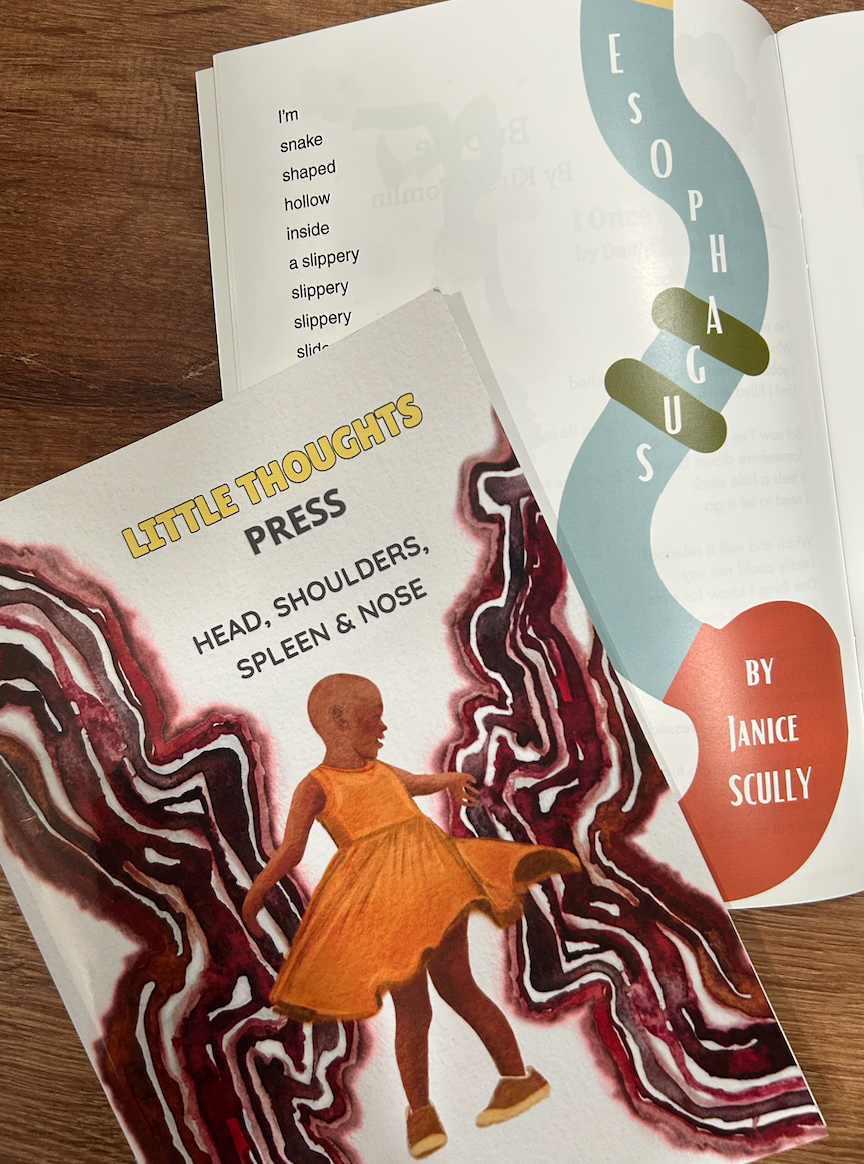
Little Thoughts Press: Your poem "Bald Lady" features a long list of delightfully creative reasons for the speaker's baldness. Some are wondrous and weird, some are very silly, others have an element of logical realism to them—"I want to be an Olympic swimmer / and baldness makes me very fast". Can you talk a bit about your process in brainstorming all of these wild ways of going bald? How would you advise fellow writers to break free from the constraints of reality if they are looking to add more playfulness and whimsy to their writing?
Annelies Judson: As a teacher and children’s writer, I work a lot with kids. Many of the ideas in the poem were off-the-cuff comments that I made to children who asked why I was bald. So some of the ‘brainstorming’ was actually just living my life as a bald teacher with a creative brain.
A lot of the other ideas were things I came up with to try and fit the rhyme scheme! That might sound a bit boring, but I actually think there’s a lot of magic to be found in constraints. For example, I had the line, I woke up one day and it was gone. So then I needed to find a rhyme for ‘gone’. I looked at the options to see if any of them could be applied to hair, and the obvious choice was ‘long’ (a slant rhyme, I know!). So then I came up with the idea of long, invisible hair, which led to the following lines, it’s there but it’s invisible/and it’s actually very, very long. The restriction of the rhyming lines means that you have to force yourself to consider how to use the limited rhyme options that you’ve got. Of course sometimes you don’t find a rhyme, and that leads you down a different path, but that too can force you into creativity.
In general I think that constraints are actually very helpful for the creative process. I love writing to a brief because it forces me to come up with ideas that fit that—and only that!—thing. You can create your own constraints or use others’. For example, there’s a children’s poetry team called The Poets XYZ (you can find their page on Facebook), and for the last three years they’ve promoted a challenge where you have to write 100 poems in 100 days. It’s hard to do, but it’s been great for getting the creative juices flowing.
Little Thoughts Press: In your author's note that accompanies this poem you write about how you have alopecia and explain, "When I lost my hair I decided that it was important to show people that it is OK to be bald, and hopefully to teach people about accepting people's differences."
Do you think kid-lit writers have a responsibility to demonstrate vulnerability to young readers? As writers, how can we best encourage both compassion and courage and are there any books or other pieces of writing that you think are especially adept at this task?
Annelies Judson: That’s a really interesting question. I don’t think that kid-lit writers have a responsibility to be anything really, beyond just good human beings. But I think the kid-lit community as a whole has a responsibility to show vulnerability, whether that is the illustrators and writers themselves, or the characters they create.
Not every creator will want to show or represent vulnerability. You may not want your characters grappling with deep subjects, either because you don’t want to write that kind of book, or because it doesn’t fit the concept or vibe of what you’re doing. (Books like How To Count To One or Oi Cat are hardly the place for emotional discussion.) And many people don’t want to be personally vulnerable, because they’re human, and that’s hard! But those of us who feel that they have the confidence or good humour to wear their vulnerability openly do, I think, have some level of responsibility. Children who are minorities of any sort, from cultural minorities to medical minorities, deserve to have role models and characters in which they can see themselves. Adults too, for that matter!
But representation is more than just for minorities. All children (and adults!) should have exposure to all the different parts of being human—not just the happy parts or the pretty parts or the parts that look and sound like their own experiences. The more that people are exposed to something, the more normalised it becomes for them. And children’s literature is a wonderful way to give that exposure, either directly via the characters and themes, or indirectly through illustrations or incidental characters.
How we encourage compassion and courage is a different part of the puzzle. Exposure is only the first step. It’s all nice and well for children to see people and stories that reflect minorities, and for kids who are part of the majority (whatever that may be in their own context), this is certainly an important part of recognising the similarities between themselves, and others who may be quite different. But I think the more important part is the discussions that we as adults have with children. If children have questions or comments about a character or a person, then by answering them with honesty and thoughtfulness, and posing questions for children to reflect on themselves, we can build up their own ability to think and reflect. And that’s the first step to compassion.
For example, my daughter recently asked about a character who was referred to by the pronoun ‘they’. (We were reading the junior fiction series Violet and the Velvets, if anyone wants to find it!) I explained about how ‘they’ is a gender-neutral version of ‘he’ or ‘she’, and why people might choose to use it. Not long afterwards, I was talking about one of our local library staff, who also uses the pronoun ‘they’. Again my daughter asked about the use of ‘they’, but this time the explanation was pretty quick because she was able to make the connection. Then she went on her merry way, because the pronoun ‘they’ is now just a non-notable part of her experience of the world. Neither of these were super deep conversations: just a few questions, honestly answered.
Any kind of difference you can think of will have been dealt with in picture books. Bodies Are Cool by Tyler Feder is great. A writer I follow online, Ryan Rae Harbuck, has just published When I Grow Up I Want To Be A Chair, which is about a kid in a wheelchair. I’m also a big fan of having incidental characters who ‘just happen to be’ different. Harriet Gets Carried Away by Jessie Sima is one of my favourite picture books, and the fact that Harriet has two dads is irrelevant to the storyline. In the middle grade/junior fiction realm, I think that R.J. Palacio’s Wonder (and the picture book version We Are All Wonders) is a stand-out example for people with physical differences. I loved Simon Sort-Of Says by Erin Rew for the way it dealt with emotional/psychological challenges. There are incidental examples in books of this level too, like Violet and the Velvets that I mentioned before.
Little Thoughts Press: How did you get started writing kid-lit and what do you find most challenging and rewarding about writing for kids?
Annelies Judson: I had wanted to write for kids for years before I started in earnest. I remember coming up with an idea for a picture book while I was in the university library writing my dissertation, and accidentally-on-purpose spending an hour of my precious study time coming up with a plot. That book has been swallowed up by the gods of obsolete hard drives. I started writing properly when my first child was young. I distinctly remember lying on my side on the carpet by his cot, holding his hand in one hand and my phone in the other, drafting a book. I wrote the whole thing in that position, just a little bit each night.
The turning point for me was 2023. That year I won a poetry competition run by The Poets XYZ, which connected me with other children’s poets. That same year I entered an award which I went on to win, and that led to my first picture book being published. All the while I was writing picture book reviews and interviewing people for a children’s literature website here in Aotearoa New Zealand (shout out to The Sapling!). Over those years I’ve become more and more connected with the kidlit community here. Making connections is really valuable because writing is a lonely business in some ways. Having a community means you get to talk shop sometimes. Plus you always have someone to turn to who can give you an opinion on a manuscript, offer advice about publishers and the publishing process, or answer random questions you have about punctuation.
What’s challenging about writing for kids is avoiding didacticism, particularly in picture books. Children’s literature has a long history of being used to educate children on the values and expectations of society. We’ve come a long way since the days of ‘the moral of the story is…’ but some books still manage to moralise in a way that I find pretty distasteful as a reader and parent. But yet as a writer, I do sometimes fall into that trap! Books should first and foremost appeal to emotion, whether that’s joy or pathos or something else. I want children and parents to read my books and poems because they get some kind of satisfaction from the story, not because they want to learn a lesson. If they gain something more from the text then that’s a bonus.
What’s rewarding about writing, for me, is the feeling of getting something ‘just right’. I love it when I find the perfect last line for a poem, or manage a great ‘mic drop’ moment, or write a metaphor that works perfectly, or find an ending for a book that brings everything together, or find a way to represent an emotion or character that feels pitch perfect. That’s not unique to writing for children of course. What is special about writing for children is that you get to share all those things when you do school visits. Adult authors are a lot more limited in their options for talking directly to their audience, I think. I love the fact that I get to regularly work with my readers.
Little Thoughts Press: Which kid-lit authors and books were your favorites growing up?
Annelies Judson: How much space have I got? Haha.
Poetry-wise, I loved, and to this day continue to love, A.A. Milne. I can still recite entire poems of his off by heart. Roald Dahl’s Revolting Rhymes was another favourite. I also remember very clearly a poetry book in my primary/elementary school library that I issued over and over again. I can remember what it felt like and vaguely what it looked like, but not the title. Unfortunately I’ve never been able to find it again! That was definitely very influential in my love of poetry. Plus of course all the rhyming picture book writers, especially those from Aotearoa New Zealand, like Lynley Dodd and Pamela Allen. When I was a teenager I discovered Ogden Nash and Edward Lear, who both write things that can be enjoyed by children too.
I read a lot of fiction from Aotearoa New Zealand as a child. Hairy Maclary was a mainstay, and Margaret Mahy’s books. As I got older, Joy Cowley, Tessa Duder, Lisa Vasil and David Hill were all in my bookshelf. I was a big re-reader as well. Although I remember going to the library and I’m sure I must have read quite widely (I was described as a ‘voracious’ reader on one of my school reports), I read the books I owned over and over. As a child of the 80s, I also remember reading lots of Judy Blume, the Anastastia Krupnik series, The Baby-Sitters Club, and my absolute favourite, Animorphs. Plus a lot of modern classics like Charlotte’s Web, Playing Beatie Bow and Bridge to Terabithia.
I think kids often don’t remember non-fiction books as clearly, but I have a strong memory of the book Tell Me Why, which I received from my grandparents with the inscription, “So you can out-knowledge the knowledgeables.” I read that book so many times. I also received a book about the natural world for Christmas one year, and I remember taking it to school stuffed with bookmarks, and sharing it with my class. I recall vaguely knowing that my teacher wanted me to finish talking but I was desperate to share everything so I just kept going, bookmark after bookmark. The class must have been so bored! Haha.
Little Thoughts Press: And what about today? Any kid-lit writers you love and want to shout out?
Annelies Judson: I’m a massive fan of Julia Donaldson’s incredible rhyming and rhythm skills. The pared-back writing and dry wit of Oliver Jeffers really appeals to me too. I also love Kes Grey, Shaun Tan (for both his writing AND his art), Philip and Laura Bunting, and Jessie Sima. And I absolutely must shout out the book Du Iz Tak? by Carson Ellis. It’s so very clever.
We have wonderful writers in Aotearoa New Zealand too. I love the linguistic nerdery that Juliette MacIver brings to her writing, and Gavin Bishop makes the most amazingly beautiful, thoughtful books. Those are just two examples from the picture book realm, but I won’t start naming more, because I’m sure to leave someone out!
I should also mention Joy Cowley. She isn’t writing any more, but two books of her writing have been published in the last few years, and books like Greedy Cat and Mrs Wishy-Washy are still being reprinted! She is hugely influential in the children’s literature community both here and overseas, and there’s a beautiful documentary about her available online, which I think everyone should watch.
Little Thoughts Press: What advice would you give to young writers?
Annelies Judson: Write.
That’s it.
Don’t worry if your spelling is wrong or you can’t remember which punctuation to use. Don’t worry if your poem isn’t perfect or your rhymes don’t work. Just write.
Then, if you feel really inspired by a particular thing you’ve written, go back and fiddle with it. Change some words around. Change them back if they don’t work. I love working on a computer for this reason. You can make multiple copies of a piece easily, and then you can compare to see if you like a previous version better.
But I would only fiddle with the things you really like. I’ve written hundreds of poems and many of them I’ve never looked at again once I’ve finished them! Maybe one day I will. But I only bother to work on the ones that really capture me, or that I want to send to a magazine or a competition. You can get too caught up in trying to make everything perfect. I don’t have the time or energy to work on everything I write, but the act of just writing them in the first place is valuable.
For the same reason, don’t even feel like you need to finish every piece of writing. I have so many poems and stories that I’ve started, but then never finished. Sometimes it’s because I realise the idea isn’t as good as I thought, sometimes it’s because something else has captured my interest, and sometimes it’s simply that I’ve forgotten about them! Obviously you want to finish SOME pieces of writing—don’t leave everything incomplete!—but definitely don’t feel obliged to keep working on something just because you started it. For me, it’s finding the balance between pushing through the challenging parts (eg. not giving up just because I can’t find a rhyme for one particular word) but also making sure that I spend time on things that I find satisfying, rather than slogging through something that I don’t think is working.
And especially when you’re young, I think just continuing to write is the most important thing you can do.
Little Thoughts Press: Is there anything else you wish I had asked? Any upcoming projects, publications, or other news you'd like to share?
Annelies Judson: I’m currently writing a novel-in-verse for young adults, which has been a good new challenge. I have no publishing news to share, but the nature of writing is that you never know when that might change! People can follow me on Instagram @annelies_judson_writer and anneliesjudson.wordpress.com for updates.


Comments