
Interview: Janice Scully

Janice Scully is a physician and loves to write for young people. Her stories have appeared in Highlights Magazine. Her poetry has appeared in several anthologies including Thanku: Poems of Gratitude (Millbrook 2019) and If I Could Choose a Best Day (Candlewick 2025) and online, including, The Dirigible Balloon. Janice Lives in Upstate New York.
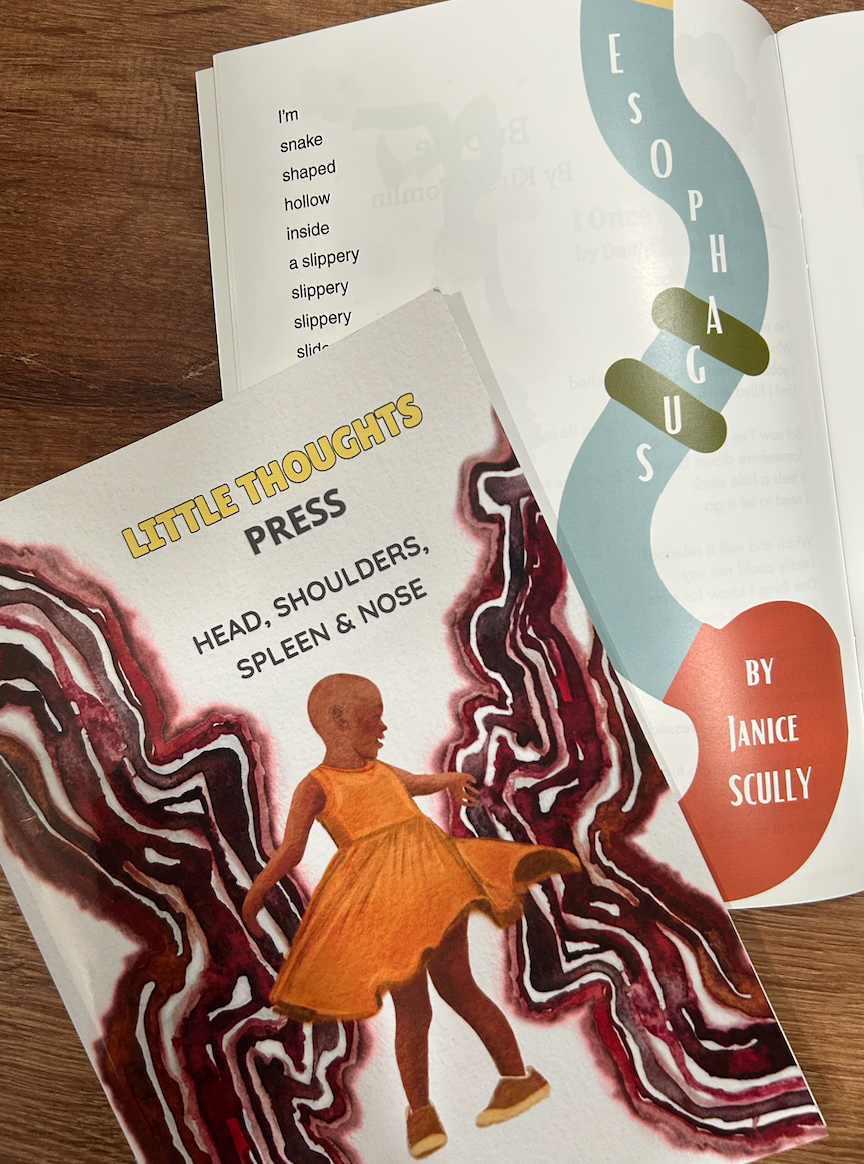
Little Thoughts Press: Your poem "Esophagus" makes great use of the s sound to create a sense of movement that resembles the movement of food down the esophagus and into the stomach. The poem feels a bit icky to read—in a good way! For younger writers, can you talk a bit about how sound and language choices can be used to create different sensations for a reader?
Janice Scully: I love language and words, most writers do. When I decided that I would have a career in science and became a doctor, I didn’t leave behind my love of writing and books. But I did add many new words to my vocabulary.
Words like “esophagus” are not used every day by most people. But like all the organs that make up our bodies, life would be impossible without an esophagus. So even as the job of delivering chewed up food to our stomach seems icky, I feel quite grateful for what the esophagus does. And because our bodies are made in much the same way, and do amazing things, all humans have a lot in common. So why celebrate it in poetry?
It helps, when writing about something icky or gross like the esophagus, to use humor. Laughing makes things seem less gross. The shape of the poem, long and skinny like the esophagus, helps us imagine the esophagus like a character in a story. Words like snake shaped, smooth, slippery, and simmering, help us imagine this “character,” this mysterious hidden part of us.
Having all these “S” words also makes the poem fun to hear, like music. Sound is part of the magic of poetry.
Little Thoughts Press: In addition to writing for children, you are a physician. You must know so much about the human body! Can you share with our readers a few facts about the body that you think are especially surprising or fun?
Janice Scully: The poem “Esophagus” is part of a larger collection of poems about the body that I’m still working on. I’m trying to make all the poems as fun as this one.
What I find amazing about the digestive system is that after we eat, food gets mixed up and taken apart. The stomach and small intestine turn all our food into it’s smallest pieces, called nutrients. Then, these smallest nutrients can be used used to repair parts of us, like our muscles. It is also used to make the energy we need to play and go to school.
The food we eat that we can’t use, we get rid in the bathroom. That’s all pretty remarkable! If you respect how your body works, you won’t take your good health for granted.
Little Thoughts Press: How did you get started writing kid-lit and what do you find most challenging and rewarding about writing for kids?
Janice Scully: I became interested in writing for kids when I had my own two little boys. The biggest challenge was writing from a child’s point of view. I started to observe nature more closely, to ask more questions, be curious. The first story I published was about a chipmunk burrow under our sidewalk. I noticed a burrow and took our brick sidewalk apart to see it. I snapped a photo of the long skinny burrow and wrote a story for Highlights Magazine. I’m still proud of that.
Little Thoughts Press: Which kid-lit authors and books were your favorites growing up?
Janice Scully: When I was growing up, there were very few kid-lit authors. I remember a series of biographies for kids I particularly liked, one about Elizabeth Blackwell, the first woman doctor, and loved reading about George Washington Carver, the famous scientist and inventor. I found them both at the public library. I would search the shelves and would take out any book that interested me. My fifth grade teacher recommended books. I read anything I wanted.
Little Thoughts Press: And what about today? Any kid-lit writers you love and want to shout out?
Janice Scully: There are too many, and I don’t want to leave anyone out. But when I studied kid-lit at Vermont College, I was drawn to middle grade authors such as Katherine Patterson, Beverly Cleary, and Jerry Spinelli. I began writing poems and discovered the poetry anthologies of Lee Bennett Hopkins and others that contained the writing of many amazing children’s poets. I read as many different authors and genres as I could.
Little Thoughts Press: What advice would you give to young writers?
Janice Scully: My advice is to read as much as you can and observe the people around you. Consider keeping a journal to jot down your thoughts. I wish I had.
Little Thoughts Press: Is there anything else you wish I had asked? Any upcoming projects, publications, or other news you'd like to share?
Janice Scully: Besides more poems about digestion, there is another project I’m finishing, inspired by my older brother. A few years ago I discovered a number of letters he wrote while he was a combat soldier in the U.S. war in Vietnam. I didn’t know he had written them. Using his letters, I have imagined a story written by a soldier’s fourteen-year-old sister during his absence. It’s written in poems. Where this war adventure will find a home, I don’t know yet, but I have enjoyed the writing.


Comments